
By David Ryan.
Where horror often permits the restoration of human order by containing or defeating the evil spirit, monster or demon, existential crisis films confront audiences with the dramatic and inevitable loss of human agency in society, politics, culture, and morality….”
Filmmakers have long dramatized the complexities of organizational culture and the patterns of work life, exploring how professional obligations shape, sustain, and often strain the lives of their characters. Other writers and directors go further by calculating how work can undermine and obstruct the very possibility of a meaningful or stable home life. In either case, the most compelling films center on people who labor toward success while simultaneously (and sometimes unknowingly) courting failure, discovering that what they invest in at work yields a mixed harvest of joy and sorrow, fulfillment and loss, achievement and disappointment—even tidal waves of betrayal and catastrophe.
Films such as Modern Times (1936), Mr. Smith Goes to Washington (1939), His Girl Friday (1940), The Best Years of Our Lives (1946), Gentleman’s Agreement (1947), Norma Rae (1979) Office Space (1999), The Devil Wears Prada (2006), Glengarry Glen Ross (1992), Network (1976), 9 to 5 (1980), Michael Clayton (2007), Wall Street: Money Never Sleeps (2010), Moneyball (2011), The Wolf of Wall Street (2013), Spotlight (2015), The Report (2019), among others, illustrate how assembly lines, clubhouses, sales floors, newsrooms, businesses, and corporate spaces are structured work systems for implementing norms, negotiating practical power, and dramatizing hierarchical identity and authority.
These films reveal how everyday interactions—among employees, managers, and executives—are shaped by the job, performance, workflow, and relationships, portraying work as a place to express ambition, conformity, integrity, dissent, and, at times, humanity. While many films dramatize (sometimes comically) interpersonal tensions as routine features of work life, other films escalate these tensions into conflicts while others amplify to crises.
What makes these latter films more interesting is that when life and death circumstances intervene, characters tend to examine the ethical bedrock (and the fault lines) of their organizations and confront the personal and social limits of their shared cultures and systems. Most of the time, these reflective actions are steeped in public values, and what we often see dramatized is the crisis of conscience when personal values confront the crises that shake the ethical fault lines and quake the lives of those who traverse the steep slopes of their crises.
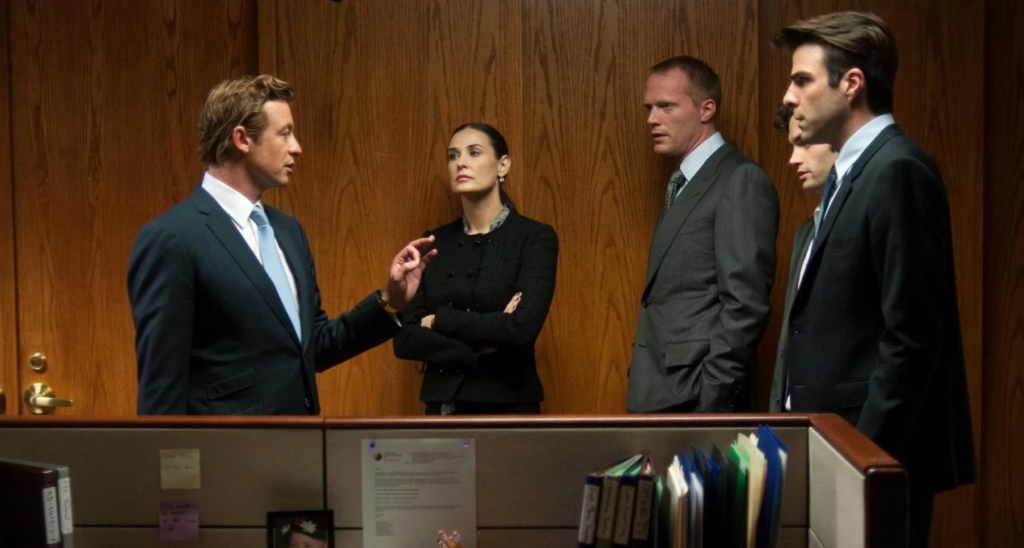
Catastrophic or existential work-related narratives—Dr. Strangelove: Or How I Learned to Stop Worrying and Love the Bomb (1964), Fail Safe (1964), The Firm (1993), Other People’s Money (1991), Apollo 13 (1995), The Insider (1999), Shattered Glass (2003), Margin Call (2011), Deepwater Horizon (2016), Only the Brave (2017), The Lost Bus (2025)—command particular interest because they dramatize human stakes embedded in very high-risk situations (certainly, the work-related problems of most police, war, and Star Trek films are parenthetically noted here), and what distinguishes these films is their movement beyond illustrating surface-level workplace norms to explore deeper human concerns, such as moral responsibility, personal integrity, work credibility, group solidarity, and the moral consequences of individual decision-making engaging with conflictive value systems.
In these crisis narratives, work is a place for demonstrating ethical and moral practices—not in the peripheral sense but in the focused lives of people who understand their roles by holding others accountable, engaging, challenging, and often accepting dubious choices, and reaffirming shared values when crises threaten to erode these values and destroy their work. This type of drama compels precisely because the stakes demand forms of character insight, wisdom, and courage rooted not only in personal conviction but in the value of moral resolve. In this way, such films posit how the work world becomes a site where ethical integrity and moral commitments are negotiated, enacted, lapsed, reaffirmed, and changed.
More recently, Kathryn Bigelow’s A House of Dynamite (2025; see top image), Paul Thomas Anderson’s One Battle After Another (2025), and Christopher McQuarrie’s Mission Impossible: The Final Reckoning (2025) focus on different strategic groups tasked with engaging different threats. Each film dramatizes how groups of people engage impending catastrophes via a specific set of crises: a geopolitical nuclear event; systemic poison and domestic terrorism; and a transcendent technological system waging 6th Generation Warfare on humanity.
Though all three foreground problem-solving groups as a way to engage their separate crises, they diverge sharply in narrative approach, character development, seriousness, and moral scope. For instance, Bigelow zeroes in on institutional systems tasked with engaging a pending nuclear attack to illustrate a large scale drama populated by professional crisis responders; Anderson turns inward toward memory, familial inheritance, and political grievances to create a carnival of caricatures in a film that seeks to entertain; and McQuarrie presents a fantasy where a singularity becomes the ultimate adversary for a small team of familiar (and some long-standing) special agents who are, for the most part, sunsetting their clandestine, high wire careers in the sunrise of new missions and adventures.
Organizational Systems and Speculative Crisis Response
On a structural level, A House of Dynamite begins by putting its audience in an inductive frame, asking us to absorb discrete scenes that build a composite understanding of various members of interlocking crisis response teams. These distributed units are unified in defending against an inbound missile launched somewhere from the western Pacific and projected to strike near Chicago.
In this short narrative window of around 20-minutes, Bigelow and editor Kirk Baxter work effectively to create montages that not only dramatize the countdown to impact but simulate how organizations process emergent information fragment by fragment, minute by minute.

As a narrative, the film unfolds in a few chaptered retellings—the opening at Fort Greely, Alaska, where Major Gonzalez (Anthony Ramos) and his advanced team detect and late-track an ICBM—and fail to destroy it. The film also focuses on the White House Situation Room, where Captain Olivia Walker (Rebecca Ferguson) leads real-time analysis while attempting to reconcile contradictory intelligence with political contingencies. The film shifts to the STRATCOM bunker, where General Brady (Anthony Letts) oversees escalating alert levels and confronts the possibility that the missile’s origin and intent cannot be confirmed. The final segment brings the crisis into the Oval Office and adjoining executive spaces, where the President (Idris Alba) and staff debate retaliation, continuity of government, and the ethical stakes of responding to a catastrophic threat of ill-defined origins.
In this squeezebox of pressure, action, and time, House does many things well, particularly establishing character identities for the ensemble—some introduced through backstory while others emerge from their work systems. What we learn about them is illustrated diegetically within the densely layered interagency structures where culture, protocol, and hierarchy shape their communication and decision-making.
The film dramatizes smartly how vertical command chains interlock with ad-hoc teams, illustrating how complex organizations form temporary problem-solving systems to engage a wicked brew of problems created by an ambiguous aggressor graded by many uncertain, unknown, and lethal variables.
As the missile crisis unfolds, the film exposes the limits of the respondent systems—and of its people. What begins as fluid, coordinated teamwork eventually buckles as the countermeasures fail and the missile descends closer to its target. Consequently, procedures become bottlenecks, communication turns static, and teams fray. In this sense, the film’s editorial strategy and its narrative schema support one another; this strategic convergence for the story, however, does break when well-rehearsed systems fail their objectives and the steeliest of characters succumb to strategic failures.
Finally, in these complex and complicated crisis situations, House smartly reveals that strategic plans are not often rigidly followed because even well-coordinated managerial systems have significant gaps, and the film scales to show that highly motivated (and delegated) decision-making systems are not always timely—and these problems are well-chronicled in the crisis response literature.
What is also chronicled is that all of the tactics, strategies, mission, objectives and goals are moral because the principles of Mutually Assured Destruction (MAD) are grounded in the context of dissuading larger-scale nuclear violence, minimizing harm to specific groups, and preserving the geopolitical order (and the humanity that sustains these specific orders). However, for the film, the practica of MAD becomes less effective precisely when those assumptive justifications fail to dissuade those who can tactically accept large scale losses, or when algorithms launch missiles when humans never would. The film falsely suggests, however, that the President must decide to hit back or not before the missile lands.

More to the point is when homogenous management systems deal with complicated information to resolve a seemingly manageable problem (shoot down one incoming missile), strategic human systems cease to be operationally rational (not to mention successful) when key technologies fail. Why? House emphasizes that strategic teams are technology dependent not only as measures of executive authority but as essential parts of their tactical plans, and when essential technologies fail, the teams lose their ability to safeguard the people they have sworn to protect—and when well-structured, problem-solving systems break, crisis managers retreat to prioritizing friends and family. On these terms, House is convincing, even compelling.
Though the combination of Bigelow and Baxter work well, when Bigelow works from the script by Noah Oppenheim, the film succumbs to a number of storytelling problems. Primarily, House falters because Bigelow poorly handles many of the human details, such as portraying a fevered boy as smirking, active, buoyant; or when the film lingers on characters dropping things or cleaning up food; and cliched transitions become labored when they digress into toys-as-metaphors, all of which are illustrated by Oppenheim’s sophomoric, non-technical dialogue that underserves his characters.
These problems are compounded further when scenes that communicate pending danger are contrasted with the play of children as well as adults reenacting a civil war battle. These artificial scenes strike as conventional lesson planning (rather than compelling drama) because they remind us that we are watching a movie where rehearsed actors enact Oppenheimer’s script and follow Bigelow’s directions.
These cumulative issues are difficult to ignore because, along this line of analysis, there is a key problem regarding Oppenheim-Bigelow’s approach to characterization: both seem to embrace the premises of John Koenig’s sonder approach to storytelling, so we are forced to recognize that every character comes from a world in which they are the main character in their own stories, so when these characters intersect, this intersection becomes Bigelow’s focus—and when major and minor characters converge, we are forced to listen to Oppenheim’s inept, soft skilled banter regarding relationships, food, and sports.
In Bigelow’s pedagogy, we are supposed to recognize this kind of communication as worthy of attention, but too often this chit-chat undercuts the main focus because of Oppenheim’s inconsequential and cringey dialogue renders many of the characters as ciphers. Sure, in real life, soft skills are important social lubricants; they are necessary interpersonal tactics that help people rhetorically navigate shared space. In reel life, however, dialogue must do more than mimic casual conversation or illustrate unsolicited and reflective optimism; it must, in some way, advance the plot, extend themes, or deepen the characters. It must not—in a film where time is valued and timing is critical—waste our time.
Secondarily, Oppenheim’s interpersonal dialogue seems intended to illustrate the crossing of vertical boundaries—power flowing between people who occupy different roles, identities, and authority. A good idea for sure, but scene after scene reveals how his intention falters: characters deliver their lines earnestly while the audience experiences an intersectional awkwardness the film never acknowledges. Rather than illuminate how status is navigated (even negotiated) or deepen narrative meaning, much of this non-technical dialogue distracts as needless embellishments—often lapsing into an incongruence that detracts from the main narrative.
Bigelow and Oppenheim may have excelled at Venn-diagramming the sonder principles on their storyboards, but skillfully dramatizing how individual characters intersect through shared experiences and managed connections are, for the most part, beyond their reach because the film often struggles with intersectional characterizations beyond creating soft-skilled sketches, rendering the individuals within those overlapping circles as marginalized role-players rather than characters who rise to engage a crisis but emerge lesser for it.
Though these story tensions are somewhat uplifted by a few solid performances from Jared Harris (stellar), Greta Lee, and, at times, Ferguson, most of the ensemble are serviceable, but others disappoint, such as Alba (and his changing accent), Letts, and Jason Clarke. But special praise goes to Angel Reese’s management for inconsequentially branding her into the film by House’s vast production team. In many ways, such a placement strikes as intrusive because it illustrates how one commodified object works in another when producers ignore that overt celebrity placement diminishes narrative value.
The Absurdist Revolts and Faux Revolutions in One Battle after Another
Though Bigelow’s drama shows that we all have stakes in organizations and that stakeholders must be managed strategically, Paul Thomas Anderson’s One Battle After Another (2025) illustrates two polarized fringe groups engaging in conflicts over a span of 16 years. To its benefit, Anderson creates characters who work within and apart from the striated social systems of American politics and its many micro-cultures. These specifics illustrate a larger conflict between those who desire a specific kind of social order and those who prefer a fearful kind of asymmetric living.
Although One Battle is not an absurdist film in a strict theatrical sense, it, nevertheless, engages—sometimes effectively, oftentimes problematically—with several features associated with the Theatre of the Absurd. Primarily, the film promotes the human desire for meaning in relation to the desire for conflict, and One Battle expresses its conflicts not in any complicated way but in simple binaries that can be easily deciphered: gun-toting, bomb-throwing radical terrorists vs. gun-using, institutionalized racists. This off-the-rack, retail approach dramatizes the sides well enough, but the rest of us have no mirrors into which to look.
At its best, the film is intermittently clever and engaging thanks to Michael Bauman’s cinematography and Anderson’s strong sense of blocking and coverage. Foremost, because the writer-director is interested in entertainment as experience, his film is populated by sharply defined characters engaged in political, social, and personal struggles that mirror the broader issues that shape them. This approach gives the film an interesting edginess that mostly steers clear of campiness.
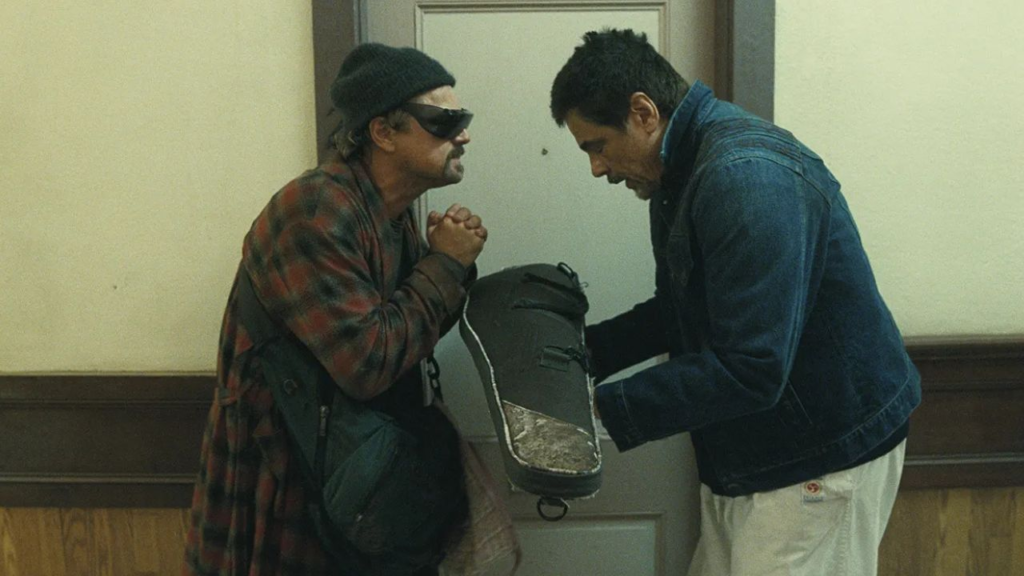
Though this action film is based on a Thomas Pynchon novel, this story is wholly Anderson’s and is stocked with a Dickensian menagerie that includes Bob (Leonardo DiCaprio), a stubborn bomb-builder and domestic terrorist gradually re-oriented (but not softened) by fatherhood; Perfidia (Teyana Taylor), a morally ambivalent and impulsive revolutionary who lives up to her name; Lockjaw (Sean Penn), an antagonistically rigid and racist career military officer on the path to promotion; St. Carlos (Benicio del Toro), a stealthy, manga-like martial-arts instructor and community leader who functions as the film’s ninjitsu ex machina; and Willa (Chase Infiniti), a smart and conflicted, self-reliant teenager who is product of an unlikely union between Perfidia and Lockjaw—but raised by the bobbing and weaving journeyman fighter in Bob.
To its credit, the film makes clear that these zealous characters possess strong moral agencies and have dedicated roles in their respective groups, and in this crisis story, Anderson pits two groups in conflict: the French 75, a highly radicalized and well-organized operation dedicated to attacking immigration enforcement and larger national boundaries (of which Bob and Perfidia are members), and the Christmas Adventurers Club, a clandestine, public-private partnership of racists working on behalf of government and corporate interests (of which Lockjaw aspires to join).
These organizations have their allies in human traffickers on one hand and the local police on the other to dramatize the systemic cooperation among different interest groups who share mutual social interests and outcomes. The effect of this binary is Willa functions as a generational fulcrum where disillusionment, memory, and hope collide in Anderson’s comically composed fever-dream of American multi-culturalism.
If the film sounds interesting as a comedic action film, it has many effective scenes, and the overwhelming critical response has been favorable with critics praising Anderson for creating a viscerally entertaining spectacle. The problem here is that though Bigelow’s big-minded effort occasionally asks its audience to look in the mirror, Anderson’s satirical film rarely holds such a mirror to its audience—only faintly pushing viewers toward reflection or self-recognition near the end because his characters appear, for the most part, in different scales of militant caricatures meant to entertain if not alienate us.
Certainly, caricatures are legible because their magnified traits make them quickly identifiable, and these traits set an emotional tone of lethality and humor gesturing toward entertainment rather than a more humanist (even absurdist) contemplation or reflection. Anderson has conveniently stocked his film with character types, and the film does explain why the characters are pinned to inherited scripts, particularly when Willa follows her dad’s (not her father’s) value system in the end due to the lethal either/or choices she faces.
For these reasons, Anderson’s film functions more as an allegory because the writer-director is consumed by subjectively teaching us lessons, exposing folly, and ridiculing specific choices, behaviors, and values. Anderson’s characters do not pretend to be organic because their symbolic purposes are illustrated at every turn. For these reasons, the film cavorts toward entertainment because it ceases to make any serious statements about the relationship between policy and politics, revolt and revolution, social justice and civil disobedience, and art and life—let alone people. The problem is that for Anderson, repetition masquerades as insight, inherited traditions as depth, and all of this is too shallow by far.

Filmmakers want their audiences to engage their art through their characters and stories, and One Battle’s endless conflicts are reinforced by the film’s reliance on caricatures shaped as much by inheriting family values as well as counter-cultural norms. Rather than depicting characters as dynamic agents capable of remaking the world, the film shows characters who inhabit roles passed down through generational habits of thought: rigid ideological postures, inherited grievances, and learned modes of opposition.
Perhaps these story points also serve as Anderson’s critiques of modern politics, but these characters are then contrasted with the two primary characters with thin backgrounds in Lockjaw and Bob. As characters, we are supposed to see them as permanent features of life in Anderson’s ameliorative world where social improvements are partially acknowledged but rarely reflected upon.
Though Anderson’s circus has interesting moments along the way, his point seems to be that political revolutions fail for two reasons: first, because its participants—confined by stereotypical identities rooted in inherited familial traditions—never confront or reinvent the dominant political culture because they self-marginalize by engaging in militant acts only; second, the dominant culture absorbs smaller changes not through elections or by winning battles but through selective social accommodation to diffuse revolutionary momentum (the scene where Bob meets his daughter’s high school friends is telling).
Otherwise, Anderson’s commitment to amplifying viewer experience manifests in a hyper-stylized sensorial overload where set pieces foreground character turbulence but favors dramatic spectacle over political reflection and deliberation, particularly highlighted in the film’s many endings. Anderson’s aesthetic prioritizes the feeling of chaos rather than the function of revolutionary praxis. As a result, the film’s attention shifts away from the revolutionaries’ ideological commitments to the audience’s moment-by-moment sensory immersion of car chases, gun play, killings, and other crisis conflicts.
This directorial and narrative choices create a narrative oddity because the story’s excesses keep viewers at an emotional high but prevents us from not only understanding how the revolutionary group works for social transformation but fails to lead to personal reflection. Curiously, only when families are threatened is when the characters think deeply about what they value the most.
Otherwise, the broader point is that revolutionaries self-marginalize by choosing violence and concealing themselves in the striations of the broader culture. These choices mean they must rely on their more normalized allies for critical help (illustrated by Bob’s escape after arrest). For these reasons, revolts spin to repetition and cease to become a revolution. The film highlights this generational entrapment by grievance, and Anderson frames conflict as a predictable ritual, a repetition of prior struggles rather than breaking from them, so it’s one tiresome battle after another, generation to generation.
And in this intergenerational trap, the militant Bob has learned that loyalty to conflict equals purpose; Pefidia is the combustive ideologue who speaks in slogans but also engages other radicals (like Lockjaw) because her transgressions know few boundaries—even betraying her peers and leaving her daughter; and Lockjaw is the veteran who repeats strategic calculations rooted in radicalized anxieties, all of which become a path up the career ladder and into a crematorium (murdered by his peers because of his relations with Perfidia). These types are not merely shortcuts for characterization; they are the film’s argument about how revolutions fail and how old power remains entrenched.
Otherwise, we’re never too sure why Bob is committed to the cause nor are we certain about Lockjaw’s choices other than there are subcultures that nurture heretical values. Though these groups mirror each other, Anderson is dishonest in illustrating their formations: the Christmas club is clandestine on one hand, but their work seems to stand for the dominant culture in the film; however, even in the unseen political world that exists outside of these two groups, we surmise that the dominant political culture is opposed to the Christmas Clubbers (that’s why this club meets and works in “absolute secrecy”). In addition, though there are a few scenes illustrating how a richly resourced French 75 are funded, the film simplemindedly suggests that armed robbery, grassroots efforts, and community activism can bankroll their systematized, longer-term activities, all achieved without clandestine government or corporate funneling.
Overall, the cast does nicely. Chase Infinity sparks Willa in all the right ways. Regina Hall emerges believably as Deandra, one whose commitments also reveals her vulnerability to conflictive pressure. Taylor enthralls as the lethal Perfidia, and DiCaprio captures both the fervor, humor, and angst as Bob. Here, however, the weakness is Penn. At 65, the actor seems too old to play a military captain, but when 16 years go by in the story, being a colonel makes more sense for this ludicrous caricature (at least Top Gun: Maverick addresses Captain Pete Mitchell’s age in relation to his rank). Here, Penn consistently chooses villainy in a one-note performance and rarely moves his character beyond the stereotypical combustions of Anderson’s constrained caricature.
Singularities and Uneasy Stages: Crisis Response at the Edge of Legitimacy
Though the business of failed revolutions is laborious work, in Mission: Impossible: The Final Reckoning, the eighth film with Tom Cruise as Ethan Hunt, and direct sequel to MI: Dead Reckoning, the Impossible Missions Force (IMF) once again operates as a paradoxical organization—an elite and clandestine crisis-response agency that is simultaneously indispensable and structurally precarious. The long-running franchise has framed the IMF as a last-resort team activated in moments when conventional intelligence apparatuses either cannot or will not intervene or when global intelligence systems fail.
This dynamic allows the long-running franchise to continue to dramatize how a small, well-resourced team can excel amid geopolitical instability, institutional compromise (and betrayal), and accelerating technological threats in its many conflicts with its enemies (rogue IMF agents, Cobalt, the Syndicate, the Apostles). However, the film creates much tension by illustrating its chronic problems with authority and accountability (but not sustainability). The treatment of the clandestine IMF team (and its various members) is a commentary on both the fantasy and perceived durability of a covert action team in the face of routinized, catastrophic threats.
Both Dead Reckoning and The Final Reckoning frame 6GW by casting the digital Entity as a militant antagonist that wages war primarily through information control and systemic manipulation. For example, the singularity falsifies data and anticipates human decisions to erode personal and institutional trust, turning perceptual sense-making itself into the primary battlefield (learning well from previous IMF tactics). The Entity embodies 6G warfare’s core logic: conflict occurring below the threshold of conventional warfare, driven by narrative dominance, cognitive manipulation, and the structured control of perception while escalating its way to nuclear conflict.
From film to film, the central strength of the IMF is its use of tight micro-work team dynamics to solve multidimensional crises. Because they are an agile organization, the IMF doesn’t have a traditional office. Hunt (Tom Cruise) and his team—Benji (Simon Pegg), Luther (Ving Rhames), and intermittent allies (Rebecca Ferguson, Hayley Atwell, Pom Klementieff)—operate with a degree of interpersonal trust and collaboration that allows them to adapt quickly to changing plans. Their improvisational ability to shift roles, share information informally, and improvise tactics under severe pressure reflects the idyllic practices of a highly-reliable crisis response unit. In addition, the franchise’s long-standing use of deception (3D printed masks, voice modulators, holograms, etc.) has made them an experienced team that uses advanced techniques to which their adversaries (in the later films) have adapted.

As the Entity escalates threats posed by the remnants of its influence (Esai Morales), Hunt’s agile team of outsiders become a state asset. In this sense, the IMF embodies a mode of crisis response that privileges adaptability and agility over procedure and mission focus not to mention oversight and administrative accountability, and their improvisational acumen, particularly in an era of cognitive-epistemic warfare, means that Hunt must not out-think or out-compute the Entity; rather, he must refuse its systemic premises and its logical chain by staying cognitively resilient and focused on alternative logical choices, the kind of choices the Entity has not learned and cannot assimilate.
To this point, Hunt prioritizes individual lives over strategic efficiency, accepts uncertainty, and creates choices that cannot be fully predicted or optimized by the Entity. The film positions Hunt’s values as strategic variables the Entity cannot assimilate because Hunt’s morality is rooted in work, friendship, constraint, trust, and tactical improvisation (including Luther’s sacrifice), and these choices cannot be learned by the autonomous economics of informational, algorithmic processes.
Here, what The Final Reckoning is telling us is that the Entity operates on the worst kinds of learned emotivism that uses manipulation to establish and preserve its dominance. In essence, in a dark, fallen world, the IMF is one organization in which the morality of loyalty, trust, and protecting innocence via self-sacrifice is beyond the utilitarian calculations of autonomous learning systems because these human choices are a higher form of virtue that, again, cannot be assimilated or learned by autonomous models
The film also foregrounds the IMF’s structural weaknesses, especially its dependence on Hunt as its emotional center, strategic leader, and moral conscience. Much of The Final Reckoning is built around the premise that only Hunt possesses the clarity of purpose, moral intuition, and improvisational capacity (not to mention his marathonal endurance) required to navigate and terminate existential threats. Though this hero-centric narrative fortifies the IMF as a resilient organization because it is no less a personality-driven team than a moral one—a crisis-response model that would probably be untenable outside of cinematic logic—thefilm argues that organizational viability hinges on a single agent’s exceptionalism, highlighting the fragility inherent in a unit that lacks a more distributed leadership (not quite MI6 and Bond, James Bond).
The IMF’s ethical and political positioning in the film further complicates its role as a crisis-response team. The Final Reckoning repeatedly places the characters in situations where they must rely on each other when they circumvent, deceive, or battle their own governmental administrators to prevent further catastrophe. For the most part, though the team is often condemned by superiors (in film to film) for its willingness to defy legal constraints, ignore protocol, and operate outside hierarchical oversight in pursuit of morally justified outcomes, they are, nevertheless, avowed and valorized for their triumphs in spite of their numerous transgressions.
This depiction underscores a recurring tension in the franchise: the claim that effective crisis management necessitates autonomy from the very institutions meant to regulate it. Why? Because the IMF takes on missions that are, of course, impossible.
By portraying rule-breaking as a necessary condition for success (even a virtue), the film elevates the IMF to a quasi-insurgent moral force while rarely raising questions about legitimacy, accountability, and the dangers of unregulated intervention. Ultimately, Mission: Impossible – The Final Reckoning presents the IMF as a symbol of both aspirational crisis competence at odds not only with its enemies but with a consistently unstable and unreliable governance that is slow to recognize IMF’s virtues and seems to care only about results. Though this recognition of the bottom line as the highest virtue, the film leans into the fantasy that a small, cohesive, improvisational cell can outmaneuver systemic threats that overwhelm (or slip through) formal institutions, but it also exposes the organizational contradictions inherent in such a model.
Through its portrayal of Hunt’s team (hyper-competent, undaunted, structurally agile, and morally moored, for the most part, to each other), the film meditates on the allure and practical limits of covert crisis responders in a world where catastrophe is imminent and authority cannot always be trusted. In doing so, the films transform the IMF into a lens through which viewers can contemplate not only the thrill of engaged crisis response but also the institutional vulnerabilities (corruption, betrayal) that make such heroism necessary.
The Existential Crisis Genre and Systemic Anxieties: A Conclusion
One Battle After Another, A House of Dynamite, and Mission: Impossible—Final Reckoning dramatize contemporary, systemic anxieties about work, power, violence, and agency, yet they arrive at sharply different conclusions about how human actors can meaningfully intervene in systems that induce tyranny and threaten destruction.
Dynamite treats its catastrophe as an ethical failure of institutions, exposing how deterrence logic and technological escalation hollow out moral culpability (but not responsibility). In simpler terms, though humans create complicated systems over which they lose control, they are still held accountable for these systems—and its apocalyptic effects. Final Reckoning, by contrast, reasserts individual agency within these systems, offering a fantasy of strategic mastery in which the disciplined expertise and moral clarity of humans can still interrupt, deflect, and end catastrophic trajectories. And One Battle occupies a more cynical middle ground, depicting revolutionary struggles against systemic problems not so much as heroic intervention but as generational repetition. For Anderson, he pins his revolutionaries to the inherited scripts of familial values and resistance, one where children not only inherit parental grievances but take on their social roles as well.
Where Final Reckoning insists on the importance of an individual’s salvific labor and House warns of the proliferation of systems that work beyond human decision-making, One Battle illustrates how the far left has little faith in politics and is stuck in its own grievance culture because their political resistance has become so generationally routinized that they would not how to govern if they came to power, so they continue to hide (in the suburbs, the woods) and disguise themselves (wearing masks, donning the religious habits of nuns) and emerge to take up arms again and again, generation to generation as a conflict of familial duty.
The three films suggest that contemporary, big-budgeted cinema remains preoccupied by the same unresolved questions—whether meaningful social change is still possible in a world influenced by inherited doctrines, maintained by artificial systems, and conflicted by competing logics of violence. As these films variously imply, humanity is trapped between and occupied by the work of maintaining larger systems of power and engaging the labor of reactive violence rather than holding a genuine interest in working toward a peaceful means of political and social renewal.
These statements raise some broader issues regarding the genre of existential crisis films and its relationship to other expressions of horror. If horror films—a cousin to the existential crisis film—create tension and conflict through the dramatization of repressed anxieties—those that disrupt the social order with what has been psychologically denied or suppressed—then, existential crisis narratives follow an alternative logic to unveil its larger scale horrors. Instead of psychological repression, these films strategically reveal the epiphanies (or dysepiphanies) of delayed realization. For instance, when confronted with existential threats, characters realize that these crises were present all along, embedded within technical systems and social structures because they are part of their values and beliefs, and continually rationalized as manageable through regular systemic interaction.
The drama, however, does not necessarily emerge with the sudden appearance of an antagonist but from the belated recognition that the conditions of catastrophe were a part of the software of our systemic thinking. Nuclear war films, autonomous AI takeover narratives, and other crisis plots do not reveal hidden fears so much as they illustrate humanity’s confrontation with the belated consequences of creating large-scale structures that require overlapping layers of administration.
Though there is a certain amount of accepted uncertainty in administering these structures, there is a greater belief in human agency to control and safeguard these processes. But characters come to realize that such structures become inaccessible and uncontrollable by design, so the failure to safeguard people is quickly realized, and either repairing or resisting these systems becomes a key choice in crisis situations.
Here, there are some storytelling parallels between horror films and existential crisis narratives that are worth pointing out. Both genres, for example, rely on common storytelling factors, such as the antagonism of an uncontrollable force (Michael Meyers on one hand, an incoming ICBM on the other); the menace of an invisible threat (ghosts, radiation, pathogens); knowledge of the “beast” as human creation (Frankenstein’s monster, atomic bomb, HAL 9000); the pains of existential dread (Freddy Krueger in our nightmares, or the nightmare of a species-wide, human-generated extinction event hitting in our lifetime); and dealing with profound institutional failures (whether it’s the repeated failure of New Jersey authorities to stop Jason Voorhees or the military command failing to shoot down an incoming missile).
When filmmakers shift from supernatural horror to catastrophic existential crises, they activate a different kind of apocalyptic imagination—one grounded not in demons or ghosts but in humanity’s ability to design and engineer its own destruction. These narratives stage a collapse of trust in the vast institutional systems built to guarantee technical and social stability. Though you might think One Battle does not apply here, it does. The systems that Bob and Perfidia battle are not solely political. Anderson makes clear that they battle a values system in which they violently disagree, and his film notes a destructive emotivism where there is no shared moral standard to resolve conflict other than through the kiss, kiss, bang, bang framework of sex and violence (as Lockjaw and Perfidia demonstrate).
In the crisis existential genre, anxiety does not leap from the haunted psyche but stems from the problems associated with the structures that organize human life. Existential crisis films dramatize the tension between humans and the large systems that govern their world—systems whose bureaucratic logic appears distant, opaque, and often beyond the reach of individual agency. In these Kafkaesque derived conflicts, characters question whether individual responsibility, ethics, or meaning can survive once control has been delegated to large decision-making structures, the kind of systems that work beyond practical human rationality and impede access to understandable, manageable, and peacefully negotiated resolutions.
Where horror often permits the restoration of human order by containing or defeating the evil spirit, monster or demon, existential crisis films confront audiences with the dramatic and inevitable loss of human agency in society, politics, culture, and morality. More so than horror films, these narratives create great unease in the recognition that the systems people create to secure their survival—environmental monitoring, climate forecasting, health support systems, agentive artificial intelligence, automated nuclear deterrence—and the belief in a professional, administrative class to manage these systems—also reveal the limits of individual authority and may signal the end of human flourishing not to mention human sovereignty itself.
David Ryan is Academic Director and Faculty Chair of the Master of Arts in Professional Communication at the University of San Francisco. He’s published widely on rhetoric and film studies and is the co-editor of David Fincher’s Zodiac: Cinema of Investigation and (Mis)Interpretation (FDU Press, 2022).
The post Circuses, Carnivals, and Other Responses: The Horror Gospels of Existential Crisis Cinema appeared first on FilmInt.nu.
from FilmInt.nu https://ift.tt/N3qDItG